
购物车空
继续购物A glove with +75% Critical Strike Damage looks like an easy upgrade. On the Season 15 Warlock build we're breaking down, it can add only a few percent to a critical hit. An off-hand with a 143%[x] bonus can more than double the damage of a qualifying skill if that bonus applies as a separate multiplier. The two rolls raise different parts of the damage calculation, and that's what makes the gap so wide.
When we sort through Diablo 4 Items after a Torment run, we start with the skill doing most of the work. Which affixes can it use? Which conditions can we maintain against the enemies that slow the build down? A roll that looks excellent while clearing stunned packs can do very little for the boss fight at the end.
We'll use Blazing Scream to follow one hit from weapon damage to its last applicable multiplier. The gear and sheet values come from the supplied Warlock example. Treat them as a build snapshot. Blizzard changed Blazing Scream's Brimstone Hunger upgrade and the Elegy sword in the Season of Hell's Legacy patch notes, so check your own skill and item tooltips before copying any of the numbers.
Turn on Advanced Tooltip Information under Options → Gameplay. Start with the sign on the affix, then read the skill tag, damage type, or enemy condition attached to it. “Damage to Crowd Controlled Enemies” and a bonus to a specific skill can both look good on paper. One needs the enemy in the right state. The other needs your damage to come from the right skill.
For the math, we sort the effects in this example into three cases.
| Affix behavior | What happens in the calculation | What we check before equipping |
|---|---|---|
| Additive bonus, shown as [+] | Eligible bonuses add to a pool. A pool of +300% gives a factor of 4.00. | How large is the pool for the hit we care about? |
| Multiplier that shares a group | Eligible values add inside the group. Two 28% rolls in the same group give a factor of 1.56. | Does the new roll apply to the skill, and what else already feeds that group? |
| Independent multiplier | The effect gets its own factor. A 65%[x] effect gives 1.65 when active. | How often does the skill or target meet the requirement? |
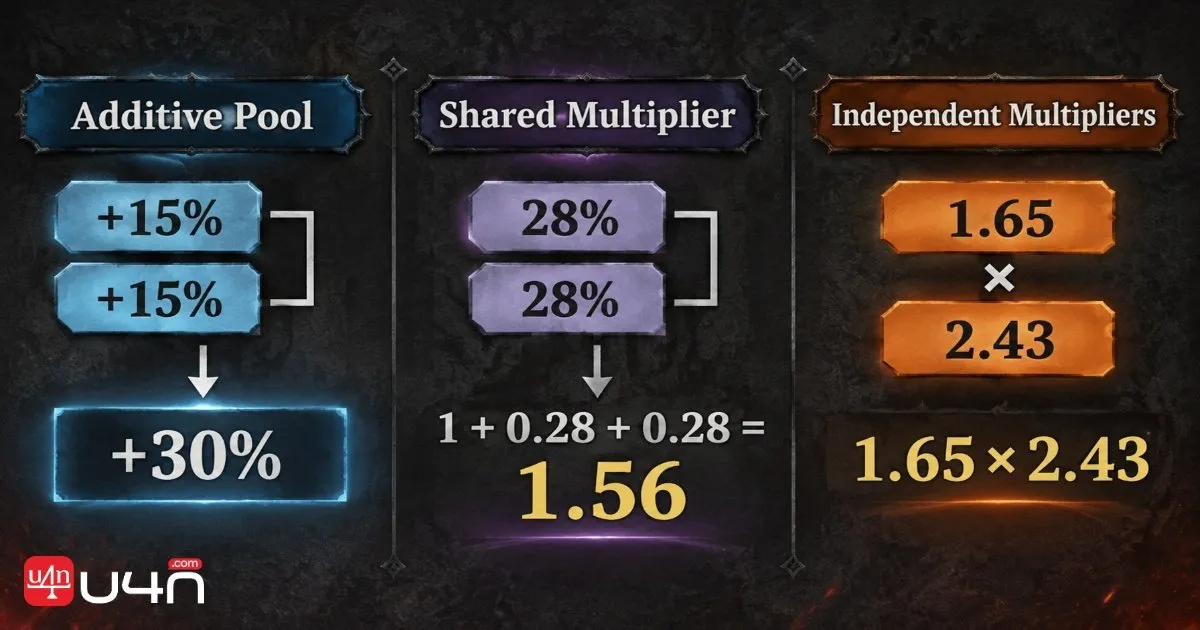
The [x] marker tells us we're dealing with multiplicative scaling. Grouping takes a second look. Blizzard's Lord of Hatred gearing notes describe how gear damage multipliers can stack additively with one another while the resulting group still multiplies damage. If two effects each show 28%, we need to establish how they stack before writing either 1.56 or 1.28 × 1.28 into the worksheet.
The Warlock in our example uses a sword and an off-hand. Their average damage values are 2,119 and 1,911, and the character sheet reports 4,030 as the weapon damage input. We use that sheet value once. The sword's listed weapon-damage roll is already reflected in the example's weapon number.
Blazing Scream shows a 799% skill coefficient in this snapshot. That gives us a factor of 7.99. The Willpower tooltip shows a separate 370.3% increase to skill damage, which gives us a factor of 4.703. Both tooltips talk about skill damage, so we label the two values separately when we do the math.
| Step | Calculation | Estimated damage |
|---|---|---|
| Weapon damage | 2,119 + 1,911 | 4,030 |
| Blazing Scream coefficient | 4,030 × 7.99 | 32,200 |
| Willpower damage factor | 32,200 × 4.703 | 151,400 |
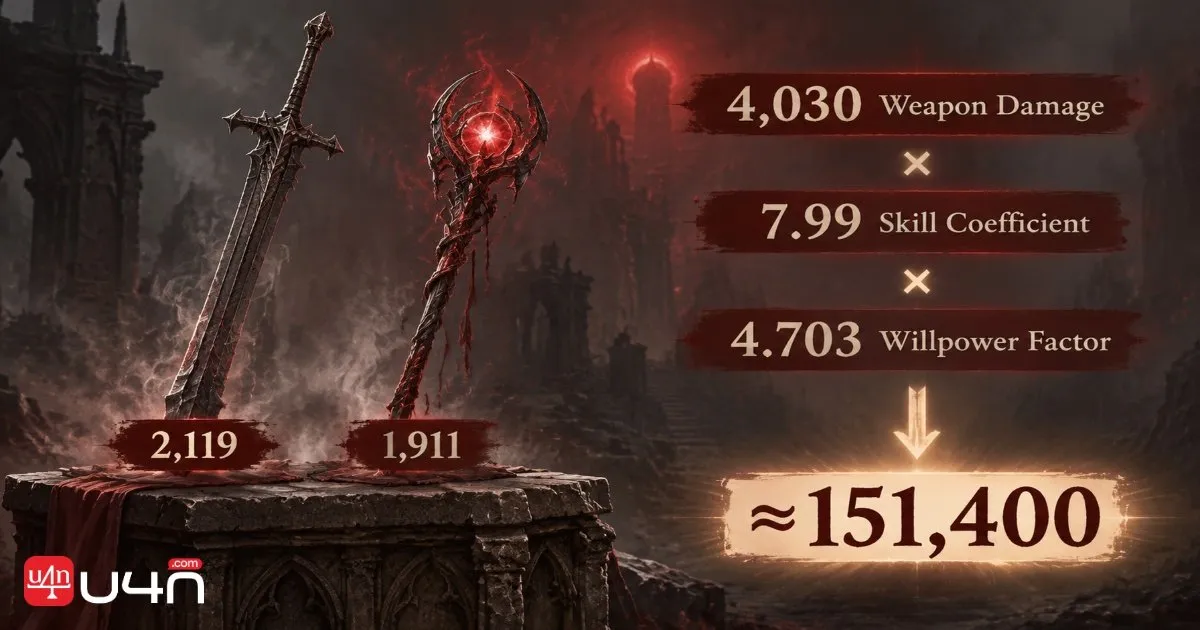
That 151,400 is the starting point for the bonuses we're about to evaluate. We've held attack speed aside because we're tracing a hit. If a gear swap also changes how many skulls connect over ten seconds, we'll need a timed test to evaluate the swap.
The example has +52.5% Damage to Elites and +235.3% Damage to Crowd Controlled Enemies. Both apply in our stunned-elite scenario, so their contribution to the worksheet is 1 + 0.525 + 2.353 = 3.878. Against an unstunned normal enemy, neither condition applies. The gear stays equipped, but those two lines contribute nothing to that hit.
Next comes the damage multiplier group used in the example. The worksheet combines 489.6% All Damage with 68.5% Fire Damage for a factor of 6.581. The 56% Holy Damage entry stays out of the calculation because we're tracking a Fire hit. This is where checking the damage type saves time. A large number in the character sheet can belong to a part of the build we aren't measuring.
The two skill-specific effects in the supplied calculation are modeled as separate multipliers. The sword's 65% Blazing Scream effect contributes 1.65, and the off-hand's 143% effect contributes 2.43 if the cast qualifies. Here's what that assumption does to the running total.
| Applied to the stunned-elite hit | Factor | Running estimate |
|---|---|---|
| Starting hit from weapon, skill, and Willpower | 151,400 | |
| Elite and crowd-control bonuses | ×3.878 | 587,000 |
| All Damage and Fire multiplier group | ×6.581 | 3.86 million |
| Sword's Blazing Scream effect | ×1.65 | 6.37 million |
| Off-hand bonus to the qualifying cast | ×2.43 | 15.48 million |
If the off-hand effect is independent, removing it drops the estimate from 15.48 million to 6.37 million, about 59%. That difference assumes everything else stays fixed. An actual replacement off-hand might change weapon damage, skill tags, or another affix, so we'd account for those changes before calling it an upgrade or downgrade.
The supplied tooltip shows about 22 million damage per skull, roughly 6.5 million above our worksheet. We'd check whether the tooltip and the worksheet represent the same hit, which skill bonuses are active, and whether any value has already been included in the tooltip. The example mentions movement-speed and target-count effects, but it doesn't isolate either one. We're leaving the gap open so the estimate remains useful without passing it off as a verified hit.
The Warlock's sheet shows 76.9% Critical Strike Chance and 2,211.4% in the displayed additive Critical Strike Damage stat. Suppose 2,211.4% is the full applicable additive pool for the hit and the candidate +75% roll is outside that pool. Under those assumptions, the new roll takes the factor from 23.114 to 23.864. That's about 3.25% more damage on a critical hit. If the glove is already equipped and its roll is included in the displayed total, use the total without that roll as the baseline.
The example also groups five Critical Strike Damage multiplier rolls into 257%, or a factor of 3.57. One glove supplies 88 percentage points of that group. If we remove that roll, the remaining factor is 2.69. Putting the roll back raises this part of a critical hit by 3.57 ÷ 2.69 - 1, or about 33%. That's the gain within this example's grouping, assuming the swap changes nothing else.
Critical Strike Chance answers a separate question. How many hits get the benefit? We estimate average damage by weighting ordinary and critical hits by their respective chances. If a roll moves the relevant chance from 76.9% to 83.0%, that's 6.1 percentage points more critical hits under the same conditions. The damage gain depends on how much harder those critical hits land. We use the chance during the actual damage window because temporary buffs can change how much room a build has before reaching 100%.

The Warlock worksheet models Vulnerable with a 1.20 baseline factor and a separate 1.75 group from two gear rolls. Together, they give 2.10 while the target is Vulnerable. The sheet's additive Vulnerable Damage belongs in the applicable additive calculation for that hit. Giving the sheet total a separate multiplier would inflate the estimate.
Using the example's 1.50 base critical factor and 3.57 critical multiplier group, we can isolate the critical and Vulnerable factors for four hit states.
| Hit state | Isolated calculation | Factor |
|---|---|---|
| Ordinary hit on a non-Vulnerable target | 1.00 | 1.00 |
| Critical hit on a non-Vulnerable target | 1.50 × 3.57 | 5.36 |
| Ordinary hit on a Vulnerable target | 1.20 × 1.75 | 2.10 |
| Critical hit on a Vulnerable target | 1.50 × 3.57 × 1.20 × 1.75 | 11.25 |
The 11.25 isolates the listed multipliers and holds conditional additive damage fixed. For gear decisions, we care about Vulnerable uptime while our main skill is landing. A setup that applies it before every burst gets more value from the same roll than one that applies it after the skulls have already hit.
We'd test this Warlock swap in the training area with the same skill variant, target setup, and starting buffs. Change one affix if possible. If the replacement also changes weapon damage or skill ranks, record those differences before comparing the results. For a skill with a target-count bonus, keep the number of targets fixed so the test measures the gear change.
Record several comparable hits with each setup. Keep ordinary hits separate from critical hits, and track which hits land during Vulnerable. If the swap also affects attack speed or how often you can cast, run a second test over a fixed time window. That gives us a way to spot a piece that raises individual hits but produces less damage over a full rotation.
| If the swap gives us… | We check… |
|---|---|
| A larger additive roll | How much it adds relative to the eligible pool already on the build |
| A larger shared multiplier | The factor before and after the swap, including the other rolls in its group |
| An independent skill multiplier | Whether it covers the skill and damage window that matter |
| More Critical Strike Chance | How much room remains below 100% during that window and how hard our crits land |
| More Vulnerable scaling | How reliably the target is Vulnerable when our main hits connect |
Before spending Diablo 4 Gold on another reroll, we keep the old piece and test against the kind of target that exposed the build's weakness. If elite packs already melt and the boss is where the run stalls, we give the boss comparison more weight.
For this Blazing Scream setup, we'd test the off-hand first. Its modeled gain is large enough to check directly under matched conditions. Once we know it applies to the skull hits we're measuring, we'd use the same setup to compare the smaller glove rolls.